Hello, I’m Jane
Like you perhaps, I’ve had an up and down journey through life.
Today I find purpose in a vision to germinate and grow nonviolent interaction between all of us humans and towards our natural world.

-
#gopeaceable – vision of a global grassroots movement

Imagine a day, not too far off, when each encounter you have is met with empathetic understanding. The person who has mistakenly tail-ended your car, the phone company employee, the government official, the person whose view on vaccination differs from your own, each listen with care to what you have to say. What if, for the first time since the decline of collaboration as the social norm 10,000 years ago, we humans have the wherewithal within easy reach to transition to a collaborative, empathetic and peaceable world?
As I see it, the happy arrival of two widely accessible social tools, Social Media and the Nonviolent Communication (NVC) model changes the ballgame. My vision is that these two concepts used together now open the way for a #gopeacable movement to emerge and ‘go viral’, normalising nonviolent interactions between people across the globe. I’m now looking for two co-visionaries to explore this vision further.

If you feel weighed down by the judgemental labels flung across social media, family dinner tables, political forums, and woven into self-talk, that separate us from each other, you are not alone. Indeed, as Johann Hari points out, “It’s no sign of good health to be well adjusted to a sick society.” What I sense is that people are poised, ready for a transformational way to safely negotiate difference and restore community. When the ship is sinking, passengers search for lifebelts.
Normalising nonviolence could avoid the ship of humanity sinking. After all, the hierarchical model of power over others so entrenched in our society is not the only way. I worked alongside the forest dwelling Ba’aka people, hunter gatherers, in Central African Republic. Like Quakers, the Ba’aka social model is based around collaboration not competition, and their is no hierarchical leadership. We in the West could structure things differently too: research shows our one year-olds are naturally collaborative until they are socialised in childhood to see right/wrong thinking and competion as the acceptable norm. So imagine our common future once organisations, government, school, and business, are redesigned for empathy and collaboration to be the expected standard.

A grassroots social movement with groundswell strong enough to open the way for the emergence of empathy as the norm for the 21st century may seem fanciful, yet it’s surely worth exploring. Let’s consider the ‘seeds of war’ in judgemental behaviour, the power of the Nonviolent Communication (NVC) way of life to transform human interactions, and how social media could role model nonviolence into the furthest reaches of the globe.
“When two people relate to each other authentically and humanly, God is the electricity that surges between them.” Martin Buber
Culture wars about ‘who is right’ and ‘who is wrong’ disconnect us from each other, yet judgemental language is currently normalised and accepted in all strata of society. Perhaps you yourself still view others through a lens of ‘who is right’ and ‘who is wrong’?
In contrast, the NVC model provides a tool to create judgement-free interactions. The approach was developed by clinical psychologist, Marshall Rosenberg (1934 – 2015) out of research into the causes of violence, and how to reduce it. Rosenberg was curious why some people remained non-judgemental and open however those around them behaved; while others shifted into blame, judgement, and retribution. He encapsulated his findings into a practical tool. For the first time, the option of a nonviolent response is in easy reach of everyone for each face-to-face, email, group or social media encounter.

It is not always clear that ‘nonviolence’ is not an absence of something. It’s actually an affirmative choice about how to show up in the world: the ‘Ahimsa’ philosophy behind Gandhi’s movement. ‘Non-violent’ people simply avoid violent acts; those practising ‘nonviolence’ choose their behaviour to build peace. That hyphen makes all the difference!
“All that has been integrated into NVC has been known for centuries about consciousness, language, communication skills, and use of power that enable us to maintain a perspective of empathy for ourselves and others, even under trying conditions.” Marshall Rosenberg
Nonviolent communication is a simple process and easy to learn. With an understanding that all humans share the same array of ‘universal basic needs’ and this is what connects us, practitioners learn to reframe dialogue in a non-judgemental way, following a four-step process: Observation – Feeling – Need – Request. With judgement removed, a person finds it straightforward to honour the needs of ‘the other’ as well as their own, needs often hidden deep below the dialogue.
It’s 5 years since a friend explained how there was an alternative way to relate to others called ‘nonviolent communication’. It was news to me: I’d been brought up to believe winning arguments and tolerating judgements that others came out with was simply ‘how the world worked’. Now that I have adopted this alternative approach to life, judgements from others (and self) no longer restrict my spirit, the bouts of depression that used to burden me have gone, and adopting an NVC approach has made interactions with others so much less stressful.
Take what happened to me last week for example. “Jane, you’re disrespectful and uncaring,” my neighbour, with whom I normally get on well, called out. Years ago, I would have reacted with self-justification, grovelling apology, or verbal counterattack, perhaps all three. No longer. At the core of NVC is the understanding that in every action or behaviour, ‘everyone is meeting their needs the best way they can at the time’, and I recognised my neighbour was doing just that, albeit in a clunky way. For unrelated reasons she’d had a difficult week, and my genuine mistake, not noticing where a friend had parked, had triggered her anger. Though her words were set to push us apart, I could look beneath her words, guessing her hidden longing for connection and empathy, and that was what I honoured. The potential ‘seeds of war’ germinated into deeper closeness.
After developing the NVC approach, Rosenberg initiated peace programs in war-torn nations, held workshops in 60 countries, and set up NVC schools. Today hundreds of NVC trainers across the globe teach this nonviolent approach to life, while many other initiatives such as the Alternatives to Violence Project, Restorative Circles, and Alcoholics Anonymous similarly seed peaceable engagement into diverse communities. At the same time within western society, growing numbers seek to transition to lifestyles in flow with the earth and their peers. Eco-philosopher Joanna Macy calls this shift, ‘The Great Turning’.
“While the initial activity might seem to exist only at the fringes, when their time comes, ideas and behaviours become contagious: the more people pass on inspiring perspectives, the more these perspectives catch on. At a certain point the balance tips and we reach critical mass. Viewpoints and practices that were once on the margins become the new mainstream.” Joanna Macy
Nonviolence still hasn’t mainstreamed though, despite these pockets of peaceable engagement. So that’s where social media, often slammed for its destructive effects on community, comes in. Like fungal mycelia that spread unseen through the soil, social media has the capacity to carry a countercultural message of nonviolence into the heart of every community in the world.
I’ve been spending an hour or two each week over the past two years on Facebook and Twitter, experimenting with NVC. I seek to engage with the angriest or most abusive person I can find and the outcomes are heart-warming. The angry, anti-government gun-toting Republican ‘antivaxxer’ turns out to be an anxious father wanting the best for his pre-schooler; the climate change denier is simply prioritising fears about mortgage payments on his family’s home if he lost his job in the oil-industry. For me, there’s still a sense of wonder every time the dialogue opens up as the other person realises there is no judgement, no ‘being right’ or ‘being wrong’.
There’s a challenge with engaging peaceably on social media though – its countercultural, so can feel lonely and rapidly drains my capacity. In a world geared for people to hold power-over positions, at times when support is lacking, it’s easy to feel like retreating to old adversarial ways. Other times, I find myself on the verge of giving up: pushback feels intense when a person swears, aims to diminish my value, or mocks my words. And while for me the words of Marshall Rosenberg hold true, “There’s no information about the person being judged in a judgment,” it’s not something I’d want others to face alone.
I envisage people coming on board #gopeaceable as self-created three-person ‘seedpods’ to ensure no-one attempts NVC without mutual support. If a person has others to mourn with when things don’t go right, and to celebrate with when they do, they are much more likely to continue with the as-yet countercultural NVC approach to life. Apps could support the movement with online NVC training and access to experienced NVC trainers, underpinned with information crowd-sourced, Wikipedia-style.
“Never doubt that a small group of thoughtful committed individuals can change the world. In fact, it’s the only thing that ever has. ” Margaret Mead
As I see it, a #gopeaceable movement with robust support would reclaim social media as a peaceable public space. (Remember when Facebook was just a way to connect with friends?) Encountering someone who has dropped judgement of others inspires curiosity and seems to be catching. Furthermore, social media provides a perfect practice space for learners of NVC because written dialogue leaves time to think. Imagine the culture of nonviolence reverberating throughout virtual spaces until it spills out across the real world.

And that’s where you may come in. Inspired by the famous injunction of Margaret Mead, I’m seeking two others to join me to meet as a ‘#gopeaceable pod’ online for the next 8 weeks to co-vision how a #gopeaceable movement could take root and grow. Are you one of them?
-
It’s not my rubbish but it’s my community!

“We are the protectors,” Max reminds others as he sets off up the wharf with bucket in hand. Once a month a ‘flashmob’ of locals, liveaboard boaties, and visitors find the 90 minutes ‘Earthcare Opua’ gathering is not only rewarding but surprisingly enjoyable!

Earthcare Opua remains deliberately unstructured. With no-one in charge, newcomers and regulars alike simply assemble in assorted hi-vis with bucket or bag and a protective glove. The group searches for litter across Opua, ‘harvesting’ debris from roadsides, tracks and the wharf. “Knowing what I have picked up may keep a seabird or fish safe, means a lot,” explains Janie, “It’s something practical I do once a month that really makes a difference!”
“I can’t believe all the cigarette butts,” a local says. “I must have picked up 100 or more, including a pile outside my mate’s business! Today I’ve found out butts contain plastic and when seagulls feed them to their chicks, it kills them. That’s so crazy! Tomorrow, I’ll be down to chat with my mate! I bet he doesn’t even realise! Maybe it’s his workers, maybe customers, but a sand can for stubs wouldn’t be hard eh?”
Amongst the liveaboards from the marina, a competitive element develops. “Anyone else find more than a dozen cable ties, ‘cut and dropped’? “ A discussion begins around small bits of rubbish washed by yesterday’s under the hard stand fence. “Another rain and they’d have been floating in the ocean!” says one overseas yachtie who sees the practical impact her work has had. ‘it’s good to help out, and, I’ll be more sparing with cable ties from now on!”
An Aucklander has come with his Opua friends. He’s shocked by the number of pie wrappers he’s picked out of marina gardens! Mainly though, he’s pleased his friends persuaded him to come along. “It’s been great to meet all you guys. I love coming up here and now I’ve done my bit to care for the Bay!”
Earthcare Opua meets outside The Opua Store the first Sunday of each month at 9am. All welcome. *Opua Store and the Marina Café kindly support volunteers bringing a reusable cup with a complementary tea or coffee after the pick-up.
Are you unable to make Earthcare Opua next month but want to do your part to protect the Bay?

Opua Business owners – your business no doubt depends on the health of the sea. Is there something more you can do to support your customers and workers to care for our Bay?
Seafarers – how many cable ties do you really need?
Smokers – could an empty Eclipse Mints tin in your pocket/bag/car be your new ‘butt holder’?
Pie lovers –Would you be willing to consider being a role model for protecting the bay?
Householders – Still taking packaging you dislike home with your purchase? Help businesses step up to their responsibility to talk with their suppliers about earth-friendly alternatives by handing packaging back in at the store. #timetoasksupplierstochange
Jane Banfield is a Paihia grandmother with a passion for the ocean. Her first introduction to yachting was to marry the Kiwi yachtsman who 35 years ago happened upon the remote island school in Vanuatu where she was a volunteer teacher. A keen kayaker, sailor and almost-daily swimmer, Jane is a self-styled ‘zero waste granny’ who has chosen a low impact packaging-free lifestyle and supports others in the Bay of Islands to do the same.
-
IF OUR MAYOR NEEDS A NEW YEAR’S RESOLUTION..
Hon. John Carter
Mayor
Far North District Council
Memorial Avenue
Private Bag 752
KAIKOHE 0440
3rd January 2018
Dear John
Will Ecostar certification for each FNDC office be your New Year’s resolution?
I hear more and more concern – from people in the Far North both in person and online. People are becoming more anxious about the amount of rubbish they create, that they see dumped in the bush, that they see being burnt and wasted and how there is a lack of focus by FNDC on helping we the people of the Far North to create less rubbish. People want to change, people are concerned, people up here care about the whenua and moana.
If we the people of the Far North are to move forward this year in embracing kaitiakitanga and becoming a region connected to and regenerating our natural world, we need leadership. Who better to lead this than you?
John, I ask that you resolve to take a new year’s step to have the FNDC lead by example with each FNDC office and department team achieving the Ecostar Award, beginning with your own. Is there any reason each office and department can’t achieve this by Easter 2018 if you both role model and request?
http://ecostar.org.nz/ : “The Far North District Council is committed to waste minimisation in the region and has set targets for the area to reach in its Waste Minimisation Strategy. To help reach those goals the Council has initiated the ecostar award to promote and recognise achievements in this area. The ecostar provides organisations with a structured process for the development, implementation and maintenance of a waste minimisation plan. The ecostar can then be gained by successfully passing an on-site audit from the Council’s approved, third-party verifiers, CBEC EcoSolutions. Current and certified members can then use their ecostar credentials as proof of their progress in implementing an effective waste minimisation plan and working towards sustainability.”
I sincerely believe that FNDC staff teams will come on board because buried deep within the spirit of each person here in the Far North is concern for our natural world. Every Far North resident needs and deserves the natural joy that comes from the guardianship of Papatuanuku and to jointly care for the future wellbeing of the next generation. We want to be known as respectful guardians and caring citizens and no longer want to accept being branded as powerless ‘council workers’ or mindless ‘consumers’. Our hearts and spirits are ready to open to a more meaningful future and we need to be shown the way step by step.
I am enclosing two small gifts for you personally, a re-usable coffee cup so you never again need to accept a disposable cup and a desk top waste box because removing the waste bin under your desk is a smart first step to focus on how to reduce your landfill footprint from your office. My wish is that each of these will daily support you and remind you of how role modelling small steps is how social change starts.
As FNDC role models its commitment to kaitiakitanga by achieving Ecostar accreditation office by office, department by department, I firmly believe it will become the start of wider change. We the people of the Far North need guidance to move from creating rubbish to valuing and looking after resources – we are ready for change, we want to change, we need you to lead us.
Meanwhile, with two others, I am working to put a water drinking and bottle refilling fountain into the Paihia waterfront to reduce plastic bottle purchases. We are doing what we can, can you please do your bit too?
Hei konā mai i roto i ngā mihi /Goodbye for now & thank you
Jane
(letter as mailed to Hon John Carter this week).
-
A NEW SONG?
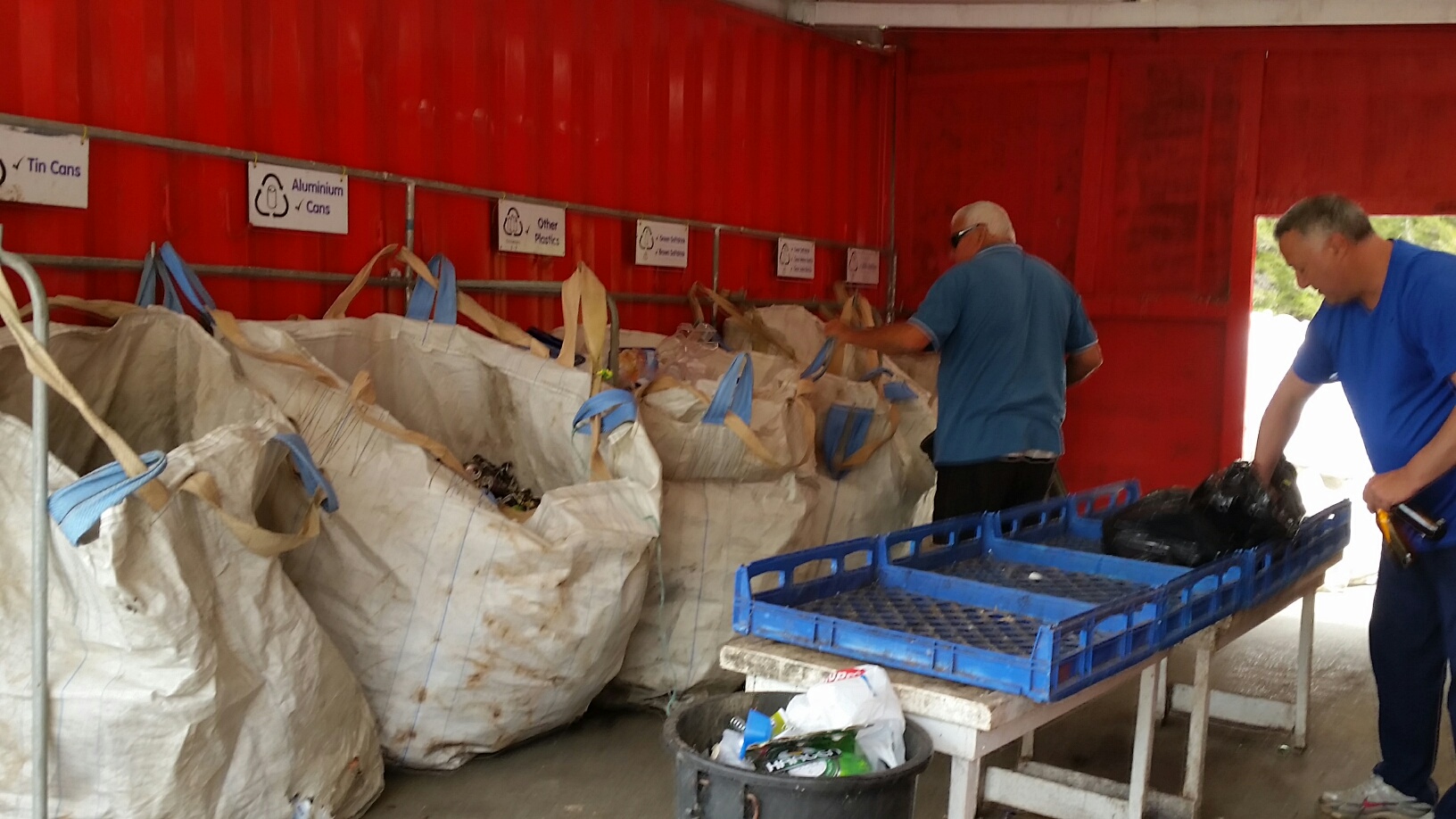
Does anyone else have as much fun as I do with their rubbish? Collecting items for composting and sorting inorganic items for various recycling streams brings a vision of my small grandson, head focused on a kindergarten sorting game. Like Oscar aged 2, I find the sorting an enjoyable challenge. “Must I really add this the landfill bin?” I question myself while seeking an alternative fit for an empty blister pack of antibiotics, necessitated by a recent bout of pneumonia. “Nope,” I say annoyed, and push it into a small catfood sack, annoyingly made of plasticised paper, that has sat in my kitchen bin for weeks destined for the landfill. The small pharmaceutical carton is added to the cardboard stack I’m collecting for recycling while the paper pharmacy bag, plastic tape first pulled off and added to the ‘soft plastic recycling’ stash, goes to my compost bucket.
What I love about my two wooden compost bins is their appetite! Claudia, my upper bin, seems insatiable: this week she had plentiful food scraps from a series of visitors along with a heap of old kale plants from replanting part of the vege garden along with some grass clippings; by the end of the week, it had all packed down and she was ready for more! For weeks now I’ve been giving Claudia food scraps, vegetable peelings and fruit skins ( minus the annoying branding labels which I stick on my ‘soft plastic’ recycling, saving the pile for my next trip for Auckland where types of soft plastic recycled are far broader than here in the Far North), garden weeds, seaweed, as well as paper and cardboard and grass clippings. Claus the lower bin is currently empty, still patiently awaiting his turn.
“Here you are, Claudia, here are today’s treasures,” I say to my gorgeous compost bin as I tear up 3 toilet roll inners along with 2 paper mushroom bags that visitors were requested to use if stopping for supermarket fruit. I’m sure I can feel my compost bin’s contentment as she settles in to look after these resources. I too feel so content: each gift to Claudia connects me once more into the circle of life; I feel connected with all the other living beings with whom I share this world. It’s a humbling experience and yet at the same time brings with it the best of endorphins – the natural joy from looking after our world’s resources is the best feeling ever.
Of course many people and businesses in the Far North have no access to a compost bin but shouldn’t this natural joy be theirs too? If Raglan’s community-owned large scale composting facility keeps waste food scraps out of the landfill and turns them into garden compost, why don’t we follow their example? Perhaps there’s still too big a big difference though between Raglan’s friendly community recycling and resource centre, Xtreme Zero Waste, and what we have so far settled for in the Far North? I admit I’m not a fan of our local FNDC Recycling Centres as exemplified by my ‘local’, the Whangae Transfer Station. Contracted out by FNDC to be run by the multi-national Chinese-owned Waste Management corporation, Whangae is a barren and soulless place. When I drive in with bottles, cans and paper for recycling to this location on the Opua-Kawakawa Road , I feel no sense of either my place within the circle of life nor my connection with other living beings. Perhaps a FNDC centre like this is not a good location for a large scale ‘Claudia? In a region where the heart of kaitiakitanga pulses as a powerful a guiding force, here at Whangae its absence is palpable. This place feels heartless, soulless, a monument to an overseas corporation whose shareholders profit from increasing the amount of rubbish we the people of the Far North throw out. Its not a comfortable fit if we are a people looking to the future.
Like rubbish itself, we residents of the Far North have for years disposed our responsibilities for looking after our environment and the future wellbeing of our community to a faceless FNDC. Its ‘their’ responsibility we say, forgetting that ‘they’ are ‘us’. An ‘out of sight, out of mind’ approach to the resources we throw out has built up as we the people of the Far North stood on the sidelines. Some years ago, I overheard two grandparents boasting about their planed ‘SKI trip’, and on admiring their level of fitness, was laughingly told, “Oh no, Jane, SKI stands for our new lifestyle, ‘Spending the Kids’ Inheritance!” This year, talking with Northlanders, its clear that the ‘SKI approach’ to rubbish no longer feels comfortable or funny; increasingly I find the people of the Far North are shocked and embarrassed at what they throw out. People are looking for a new theme song.
Its hard to hear a new song amidst the familiar old lyrics. “Its not my fault. I recycle where I can. I don’t drop litter. My rubbish gets picked up from the kerbside” can still be heard amidst the back patting. “We’ve no choice,” Far North citizens chorus as they continue to purchase plastic packaged items within a system that is neither fair, ethical or sustainable. But do we in the Far North really have no choice? Are we stuck or is there a new song in the air? Is there a heartfelt and healing new ‘post-disposable’ harmony on the lips of Far North citizens young and old? Without doubt, my own song is changing. Just 18 months ago when out with friends, at work or looking after my family’s needs, ‘convenience’ and ‘disposability’ guided my choices and the value I put on time. No longer. Today my desire for that natural joy that comes from connecting with the natural world has become so important that reducing my rubbish footprint is essential. I’m no longer prepared to accept being labelled as a mindless ‘consumer’ with no feelings and values of my own. I’m not mindless, I’m a citizen and a Far North resident and I care.
It dawned on me that I can sum up this new approach of mine with 3 ‘R words’: rethink – reorganise – request. Is it time yet for all in the Far North to sing a new song to bring healing to our community as we heal our environment? Are Far North citizens keen to honour their place within the natural world by choosing a future where landfills are history and items are re-valued as resources not rubbish? If so, perhaps these 3 words will become the chorus line of a new song as we each Rethink, Reorganise and Request a rubbish-free Far North?
-
A PEDALLER’S MUSINGS
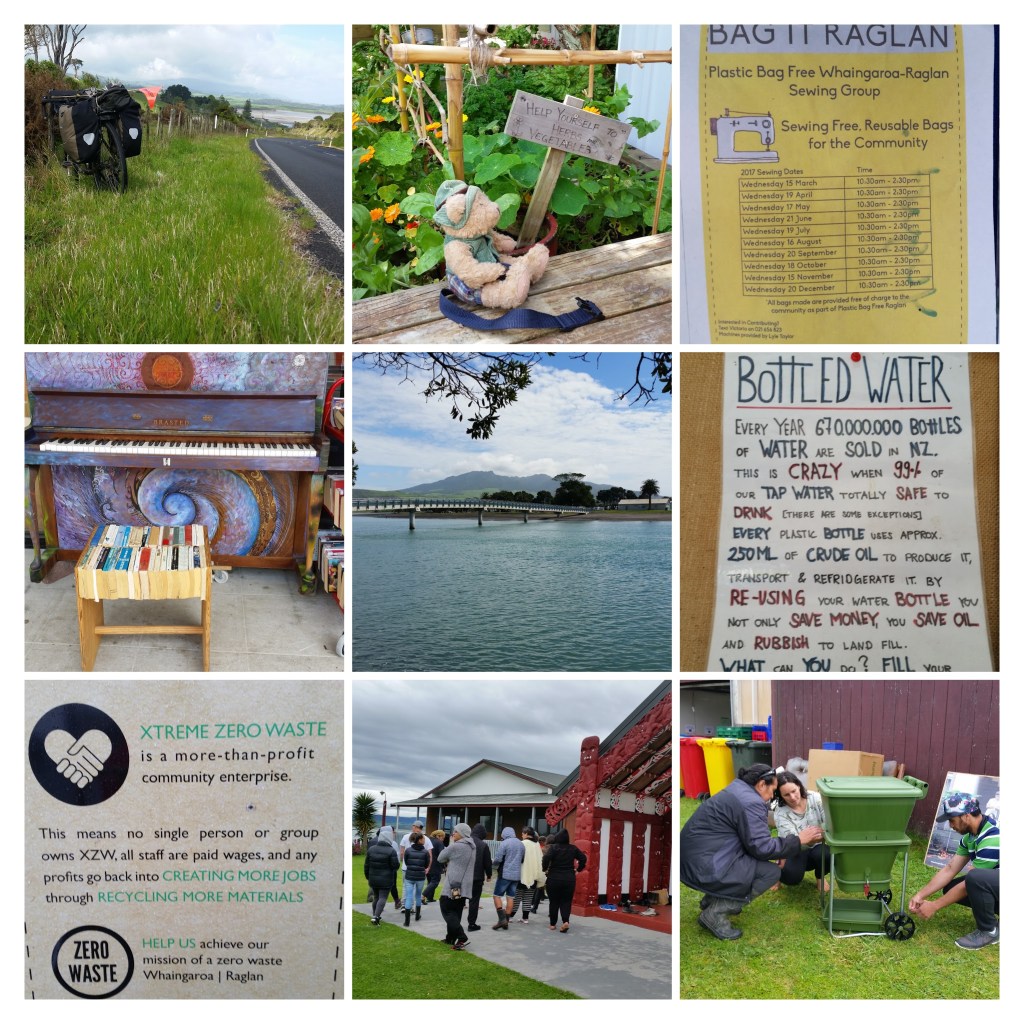
South of Auckland on my daughter’s old touring bike, I’m heading for the annual Para Kore Hui being held this year at Maketu Marae, Kawhia. Para Kore (Te Reo for ‘Waste Zero’)Its an awesome not-for-profit organisation filled with creative, far-sighted individuals, whose vision is for every marae in Aotearoa to be on the ‘Para Kore’ journey by 2020, so I feel honoured to once again be gathering with fellow Kiwis from every walk of life to share understanding and experiences in this kaupapa.
As I pedal, its impossible not to notice the bottles and cans randomly ‘decorating’ the verge. Out of interest, I note an average of 4 drinks containers every 100m, which doesn’t seem so bad until I calculate that on today’s 53km ride to Waingaro Hot Springs, I will, when the opposite side of the road is factored in, pass 4160 drinks containers. From experience of similar numbers back home in the Bay of Islands, I start multiplying up what this means for the quantity number of drinks containers scattered along all the roadsides of New Zealand, until my mental arithmetic skills finally let me down. Sensitive to our finite world I grieve at this wastage, feel anxious about the effect of this rubbish on the natural world, and am frustrated my own need for harmony and connection with the beauty of the countryside is sorely interrupted.
Now, as I push my bike up the longer hills, more aware than ever of the scope of this problem, the words of Marshall Rosenberg, the creator of the ‘non-violent communication’ approach (which has so radically changed my own worldview) come to mind:
‘Getting people to stop doing something is a loser’s game’/’Everything that a person does is in order to meet a need’/ ‘People will change when they find a way to meet these same needs at a lower cost to themselves and others.’
So, I ponder, “When they toss a drink container out of a car, what needs might this person be meeting? ” and come up with 4 possible scenarios:
- They have a need for a tidy car (men in particular, I’ve been told, see their car as an extension of themselves)
- and know of no other place as simple to access for this end-of-life packaging
- and/or in their thinking, they are throwing it ‘away’ without thinking through that there is no ‘away’ : packaging remains where it lands or is washed to sea
- They need to hide their spending/drinking/consumption from someone
- They need space in their car for new items/extra people they will be giving a lift to
- They need to watch costs and are anxious about the cost to add to their roadside rubbish/recycling collection
Whatever their need, Marshall Rosenberg explains positive change happens when people find a way to meet their need at a lesser cost. In many countries, advanced deposits on drinks containers have created the focus for people to meet these same needs at less cost to their own self-respect, to taxpayers and to the environment. (South Australia has had bottle refunds for years, and by mid-2018 the same system will be up and running in every state in Australia, while in Canada and Germany successful schemes have run for years – Germany has an almost 100% recycling rate for drinks containers). However, although since 2008 here in NZ our ‘Waste Minimisation Act’ has allowed for the introduction of an advanced deposit scheme, in the face of lobbying from the packaging and drinks companies, our previous government lacked the will to bring this about.
So now is our chance! And it’s a no-brainer, it has been shown it will create 2400 more jobs in the regions, greatly reduce costs to ratepayers, while adding only add 0.5c to the cost of a product which will be paid for by those using the product, the consumers. 90% of NZ Councils have requested it and 86% of Kiwi citizens surveyed by TVNZ last year stated their wish to see a refund scheme in place. I’ve come across the same positive support myself in the Bay of Islands, when I’ve asked locals to provide signatures for the ‘Kiwi Bottle Drive’ petition, with older Kiwis harking back to childhood fund-raising and overseas visitors/younger Kiwis sharing their appreciation of money-back systems experienced overseas. Even Matt King, prior to being elected our new local National Party MP, ignored his government’s stance on the issue and signed his name in support. Indeed nobody I have approached has refused to sign, so I’m confident this is the way to go, we just need to create momentum for change, strong enough to overcome the corporate lobby.
So dear reader, I won’t tell you how or what to do. I am confident you will add to this momentum in your own way. I’m collecting signatures for the Kiwi Bottle Drive but maybe you are a letter-to-the-editor writer, someone who takes time to explain to friends what is needed and why, someone in touch with their local MP or Councillor, or perhaps one who tweets or comments on a drink’s company Facebook page? I just know we are each part of the solution, when we the people of New Zealand combine voices in supporting our new Government to regulate for advanced deposits on bottles and cans, recycling rates will double and these roadside verges will empty. #togetherwecandoit
- They have a need for a tidy car (men in particular, I’ve been told, see their car as an extension of themselves)
-
ZERO WASTE ALONG THE TWIN COAST CYCLE TRAIL?

Email Monday 20th March to Hon John Carter QSO, Mayor Far North District Council
Dear John
The Cycle Way is awesome! I loved riding it on Saturday, as did the friend I roped in who hadn’t been on a bike for years! I’m now looking forward to my daughters, son-in-law and visitors from overseas riding that part in the near future! Its so good to see this project come to fruition – all credit to the Green Party for initiating the concept around NZ, all those individuals who have pushed it along, and for your Council following up on it. I love the idea of new parts of Northland being opened up to such a gentle way of seeing our region.
However, I am concerned that we keep the Trail ‘clean and green’. As you will see from pic, on Saturday I already picked up a considerable amount of waste ( and had to leave more behind as I couldn’t carry it)! I believe we need to create a culture right from the start which proactively educates NZ and overseas riders – and locals – in a ‘ Zero Waste Kaitiakitanga’ :
- Lets make it easy for riders to make good choices which protect our land and sea environment and lets create fun signage about why using primary school kids art works
- Lets ensure local people , trustees, Iwi and business people build a culture of stewardship of our Northland Environment right from the start.
- Lets keep plastic from affecting fish stocks, shellfish and other marine life. It needs to be recognised that the waste that gets dropped will be washed by rainstorms into drains and hence into the sea ( see pic of plastic yoghurt carton almost there – on side of marsh raised walkway) – the trail is highly vulnerable, given sections by rivers, by streams, and by the coast
- Sophisticated European tourists don’t want to see the amount of rubbish that I for example picked up along the trail on Saturday ( see pic of my ‘hoard’ at the finish showing as much as I could carry: 3 cans, 6 PET soft drink bottles, 5 crisp packets, 1 pie bag, 2 flavoured milk bottles, 1 yoghurt carton but had to leave many other items I was unable to carry) ) . Lets aim for rave reviews about our environmental policy on the Trail.
- Lets showcase that ‘Northlanders care’ about generations yet to come and about our natural world
Why not
- Set a goal say for July 2018 whereby the Twin Coast Trail will be a fully Zero Waste Trail
- Raise awareness of the issues amongst trustees by sharing this short video : http://www.dailymotion.com/video/x5d2fqg_it-s-time-to-ditch-the-disposable-plastics_news
- Define Zero Waste = No rubbish whatsoever that goes to landfill = anything that’s discarded becomes a resource for something else. This means switching to reusable, compostable and recyclable food and drink packaging
- What makes a ‘ Zero Waste Trail’ would best be brainstormed by those involved but here are 10 ideas for starters:
-
- All businesses along the Trail must be Ecostar rated by July 2018 in order to be promoted on maps, website etc
- Signage created by schoolkids (after all , it is their future that is at stake) describing why the Trail is Zero Waste and why its important ( Opua School kids already do great art work around the issues of waste/marine plastic for example) at intervals along trail – request sponsorship from Waste levy funding perhaps to pay for signs?
- In promotional material, strongly discourage riders from carrying any disposable plastic items such as single use water bottles, food packaging etc by explaining the Zero Waste policy and reasons why
- ‘Leave only footprints’ ( or ‘Leave only cycle tracks’) message to be promoted and/or http://www.take3.org/
- Ban businesses from using disposable cups/glasses (Interestingly the café we stopped at above the stream half way along was saying how they were really aware that they didn’t want to use the disposable cups they were supplying and felt bad that they were doing so but weren’t organised enough – it is my belief this is true of many, they want to make more eco-friendly choices but need leadership to do so)
- Set up a few water bottle refilling stations (like Opua School’s gift to Paihia ( set up on Horotutu by the Info Centre)
- Sell stylish customised Trail branded re-usable cups at start and finish of trail sections and at each cafe along the way eg http://www.cuppacoffeecup.com/nz/customise/
- Sell customised re-usable metal water bottles eg http://www.ipromote.co.nz/promotional-products/drink-bottles
- Encourage sale of items with compostable packaging such as Trade Aid chocolate bars / various coffee roasters bags
- Make it a trend to have cafes and maraes using funky mismatched op shop cups or mugs / glasses and no disposable ones
- Ensure ALL further FNDC events such as that held at Horeke on Saturday are Zero Waste ie all items used can be and are recycled or composted. ( Many Councils around NZ now hold only Zero Waste Events cf http://www.kapiticoast.govt.nz/Our-District/on-to-it/sustainable-communities/zero-waste-events/ so no glad wrap over food, no food in soft plastic wrapping eg crisps, biscuits etc ( until soft plastic recycling is brought in in Far North ), no disposable cups, plastic bottles of water – replace with filling station and remind people to bring their own bottles – etc. (Once FNDC is Ecostar-rated itself of course this will become second nature…😊)
Not only will this focus on Zero Waste for the Trail be useful in itself, it will also give Far North citizens (and FNDC) an aspirational target to achieve for other ventures. #togetherwecandoit
What do you think?
-
WASTE-FREE IN THE FAR NORTH?

‘Humanity has developed a very deep ability to push devastating information about the impacts of our actions into our subconscious and this is a danger. We are numbing ourselves to this life going out’. Patricia McCabe
Here’s what my heart and soul wants to say to you, Dear Reader. That Rumi’s words from the 13th century (see pic) speak just as true today; its high time to meet beyond ideas of ‘wrongdoing and rightdoing’ here in the Far North! Can we please put aside blame and judgement in regard to Waste, celebrate that there is much more that unites us than divides us, look for the good in each other, and get on and work together to move forward?
The issue of Waste and its effect on the environment here in the Far North is a prime example of what sociologists and others term a ‘wicked problem’ or a ‘mess. Its a problem with no single cause and there is no one solution, and actually there is little likelyhood of the problem ever being completely resolved, so can everyone please stop taking sides, and saying one idea is good, another is not. Nor are some organisations or individuals wholly good or wholly bad. Nothing is that black and white. This being so, the best, indeed many would say the only way that wicked problems can be effectively addressed is by the many stakeholders coming together to identify the root causes and the best possible group of potential albeit partial solutions. Once causes and possible solutions are made visible in a spirit of openness and collaboration beyond rightdoing and wrongdoing, then different groups, organisations and individuals can take responsibility for ‘doing their bit,’ collaborating all the while and coming together regularly to check on forward progress and revise and adjust the best ways to tackle the next stage.
So following on from that, my activist/pragmatist mind suggests this. Its high time , indeed well overdue that we, that is the People of the Far North, provide a clear and visionary voice about our needs in relation to Rubbish and Recycling. We’ve been far too quiet for far too long. Before the Far North District Council ratifies a new Waste Management and Minimisation Plan in June 2017, do you, Dear Reader, have a vision that speaks for us all? If yes, and we are all in need of the vision of those brave of heart and clear of mind, please may you share it with us all. If not, Brave Reader, do you have courage enough to honour my vision as drafted below, all or in part? Will you stand beside me so our combined voices call out on behalf of ourselves but more for the vulnerable young children of today here in Northland whose future health and wellbeing is so much in our hands?
A (draft) COLLECTIVE VISION FOR THE PEOPLE OF THE FAR NORTH
We, the people of the Far North, choose for life to flourish throughout our region through the wise re-use of all resources and the elimination of harm from packaging and other waste:
- We have a key desire to leave for the latest generation (those born since 2010) a healthy, flourishing and biodiverse region providing well-being for all;
- We believe in working together with wisdom, compassion and empathy to bring well-being and harmony for the people and the natural ecosystems of our Far North region;
- We look for possibility, partnership and peace;
- The rights of current and future generations of Far North people are key;
- Subsidiarity ( decision-making at the level of those most affected) is key;
- Collaboration of stakeholders is seen as the best way to reach negotiated outcomes that realistically best meet the needs of all Far North people.
To achieve our vision, we Far North people call on FNDC to host a quarterly meeting throughout the period 2017 – 2022 between representatives of the following 5 Stakeholder Groups for collaborative discussion/decision-making using a quadruple bottom line approach (people+planet+profits+sourcing people’s wisdom) to support us, the people of the Far North to achieve our vision for life to flourish throughout the Far North through Wise re-use of all Resources and the elimination of Harm from Packaging and other Waste .
Stakeholders:
- Maori
- ‘Waste Warriors’ – a Far North alliance of local community/not-for-profit organisations and individuals committed to waste minimization/waste harm reduction & education
- Business – Directors of Companies, Individuals and Member bodies involved in the production, importation, sale, use and distribution of packaging and packaged products in the Far North;
- Spokespeople representing
- the rights of children under 16
- those yet to be born (2017 – 2030)
- today’s youth (17 – 25)
- parents of children under 16
- other Northland residents
- the biodiversity of Far North bush
- the biodiversity of Far North marine life
- Public Sector – FNDC, Northland Health, NRC and Government
Furthermore, we the people of the Far North have the expectation that each of the above stakeholder representatives at the Quarterly meeting will acknowledge and honour their personal, organisational and collective responsibility for stewardship and restoration of our natural world here in the Far North, respecting the strengths and unique requirements of local communities and the dignity of individuals.
We further expect that every one of our elected Councillors will honour their personal responsibility to bring alive the FNDC Vision 2015-2020: FNDC will be a capable, trusted, and innovative civic leader, serving and inspiring people, maximising opportunities to empower communities and meet their changing needs; while creating great places.
So, brave reader, to repeat my question to you, ‘Do you have courage enough to ask for the vision above, all or in part, to be honoured here in the Far North, and stand beside me so our voices speak for ourselves and for vulnerable children here in Northland whose future health and wellbeing is so much in our hands? ‘

About Me
The sky is not completely dark at night. Were the sky absolutely dark, one would not be able to see the silhouette of an object against the sky.
Follow Me On
Subscribe To My Newsletter
Subscribe for new travel stories and exclusive content.

