Hello, I’m Jane
Like you perhaps, I’ve had an up and down journey through life.
Today I find purpose in a vision to germinate and grow nonviolent interaction between all of us humans and towards our natural world.

-
#gopeaceable – vision of a global grassroots movement

Imagine a day, not too far off, when each encounter you have is met with empathetic understanding. The person who has mistakenly tail-ended your car, the phone company employee, the government official, the person whose view on vaccination differs from your own, each listen with care to what you have to say. What if, for the first time since the decline of collaboration as the social norm 10,000 years ago, we humans have the wherewithal within easy reach to transition to a collaborative, empathetic and peaceable world?
As I see it, the happy arrival of two widely accessible social tools, Social Media and the Nonviolent Communication (NVC) model changes the ballgame. My vision is that these two concepts used together now open the way for a #gopeacable movement to emerge and ‘go viral’, normalising nonviolent interactions between people across the globe. I’m now looking for two co-visionaries to explore this vision further.

If you feel weighed down by the judgemental labels flung across social media, family dinner tables, political forums, and woven into self-talk, that separate us from each other, you are not alone. Indeed, as Johann Hari points out, “It’s no sign of good health to be well adjusted to a sick society.” What I sense is that people are poised, ready for a transformational way to safely negotiate difference and restore community. When the ship is sinking, passengers search for lifebelts.
Normalising nonviolence could avoid the ship of humanity sinking. After all, the hierarchical model of power over others so entrenched in our society is not the only way. I worked alongside the forest dwelling Ba’aka people, hunter gatherers, in Central African Republic. Like Quakers, the Ba’aka social model is based around collaboration not competition, and their is no hierarchical leadership. We in the West could structure things differently too: research shows our one year-olds are naturally collaborative until they are socialised in childhood to see right/wrong thinking and competion as the acceptable norm. So imagine our common future once organisations, government, school, and business, are redesigned for empathy and collaboration to be the expected standard.

A grassroots social movement with groundswell strong enough to open the way for the emergence of empathy as the norm for the 21st century may seem fanciful, yet it’s surely worth exploring. Let’s consider the ‘seeds of war’ in judgemental behaviour, the power of the Nonviolent Communication (NVC) way of life to transform human interactions, and how social media could role model nonviolence into the furthest reaches of the globe.
“When two people relate to each other authentically and humanly, God is the electricity that surges between them.” Martin Buber
Culture wars about ‘who is right’ and ‘who is wrong’ disconnect us from each other, yet judgemental language is currently normalised and accepted in all strata of society. Perhaps you yourself still view others through a lens of ‘who is right’ and ‘who is wrong’?
In contrast, the NVC model provides a tool to create judgement-free interactions. The approach was developed by clinical psychologist, Marshall Rosenberg (1934 – 2015) out of research into the causes of violence, and how to reduce it. Rosenberg was curious why some people remained non-judgemental and open however those around them behaved; while others shifted into blame, judgement, and retribution. He encapsulated his findings into a practical tool. For the first time, the option of a nonviolent response is in easy reach of everyone for each face-to-face, email, group or social media encounter.

It is not always clear that ‘nonviolence’ is not an absence of something. It’s actually an affirmative choice about how to show up in the world: the ‘Ahimsa’ philosophy behind Gandhi’s movement. ‘Non-violent’ people simply avoid violent acts; those practising ‘nonviolence’ choose their behaviour to build peace. That hyphen makes all the difference!
“All that has been integrated into NVC has been known for centuries about consciousness, language, communication skills, and use of power that enable us to maintain a perspective of empathy for ourselves and others, even under trying conditions.” Marshall Rosenberg
Nonviolent communication is a simple process and easy to learn. With an understanding that all humans share the same array of ‘universal basic needs’ and this is what connects us, practitioners learn to reframe dialogue in a non-judgemental way, following a four-step process: Observation – Feeling – Need – Request. With judgement removed, a person finds it straightforward to honour the needs of ‘the other’ as well as their own, needs often hidden deep below the dialogue.
It’s 5 years since a friend explained how there was an alternative way to relate to others called ‘nonviolent communication’. It was news to me: I’d been brought up to believe winning arguments and tolerating judgements that others came out with was simply ‘how the world worked’. Now that I have adopted this alternative approach to life, judgements from others (and self) no longer restrict my spirit, the bouts of depression that used to burden me have gone, and adopting an NVC approach has made interactions with others so much less stressful.
Take what happened to me last week for example. “Jane, you’re disrespectful and uncaring,” my neighbour, with whom I normally get on well, called out. Years ago, I would have reacted with self-justification, grovelling apology, or verbal counterattack, perhaps all three. No longer. At the core of NVC is the understanding that in every action or behaviour, ‘everyone is meeting their needs the best way they can at the time’, and I recognised my neighbour was doing just that, albeit in a clunky way. For unrelated reasons she’d had a difficult week, and my genuine mistake, not noticing where a friend had parked, had triggered her anger. Though her words were set to push us apart, I could look beneath her words, guessing her hidden longing for connection and empathy, and that was what I honoured. The potential ‘seeds of war’ germinated into deeper closeness.
After developing the NVC approach, Rosenberg initiated peace programs in war-torn nations, held workshops in 60 countries, and set up NVC schools. Today hundreds of NVC trainers across the globe teach this nonviolent approach to life, while many other initiatives such as the Alternatives to Violence Project, Restorative Circles, and Alcoholics Anonymous similarly seed peaceable engagement into diverse communities. At the same time within western society, growing numbers seek to transition to lifestyles in flow with the earth and their peers. Eco-philosopher Joanna Macy calls this shift, ‘The Great Turning’.
“While the initial activity might seem to exist only at the fringes, when their time comes, ideas and behaviours become contagious: the more people pass on inspiring perspectives, the more these perspectives catch on. At a certain point the balance tips and we reach critical mass. Viewpoints and practices that were once on the margins become the new mainstream.” Joanna Macy
Nonviolence still hasn’t mainstreamed though, despite these pockets of peaceable engagement. So that’s where social media, often slammed for its destructive effects on community, comes in. Like fungal mycelia that spread unseen through the soil, social media has the capacity to carry a countercultural message of nonviolence into the heart of every community in the world.
I’ve been spending an hour or two each week over the past two years on Facebook and Twitter, experimenting with NVC. I seek to engage with the angriest or most abusive person I can find and the outcomes are heart-warming. The angry, anti-government gun-toting Republican ‘antivaxxer’ turns out to be an anxious father wanting the best for his pre-schooler; the climate change denier is simply prioritising fears about mortgage payments on his family’s home if he lost his job in the oil-industry. For me, there’s still a sense of wonder every time the dialogue opens up as the other person realises there is no judgement, no ‘being right’ or ‘being wrong’.
There’s a challenge with engaging peaceably on social media though – its countercultural, so can feel lonely and rapidly drains my capacity. In a world geared for people to hold power-over positions, at times when support is lacking, it’s easy to feel like retreating to old adversarial ways. Other times, I find myself on the verge of giving up: pushback feels intense when a person swears, aims to diminish my value, or mocks my words. And while for me the words of Marshall Rosenberg hold true, “There’s no information about the person being judged in a judgment,” it’s not something I’d want others to face alone.
I envisage people coming on board #gopeaceable as self-created three-person ‘seedpods’ to ensure no-one attempts NVC without mutual support. If a person has others to mourn with when things don’t go right, and to celebrate with when they do, they are much more likely to continue with the as-yet countercultural NVC approach to life. Apps could support the movement with online NVC training and access to experienced NVC trainers, underpinned with information crowd-sourced, Wikipedia-style.
“Never doubt that a small group of thoughtful committed individuals can change the world. In fact, it’s the only thing that ever has. ” Margaret Mead
As I see it, a #gopeaceable movement with robust support would reclaim social media as a peaceable public space. (Remember when Facebook was just a way to connect with friends?) Encountering someone who has dropped judgement of others inspires curiosity and seems to be catching. Furthermore, social media provides a perfect practice space for learners of NVC because written dialogue leaves time to think. Imagine the culture of nonviolence reverberating throughout virtual spaces until it spills out across the real world.

And that’s where you may come in. Inspired by the famous injunction of Margaret Mead, I’m seeking two others to join me to meet as a ‘#gopeaceable pod’ online for the next 8 weeks to co-vision how a #gopeaceable movement could take root and grow. Are you one of them?
-
It’s not my rubbish but it’s my community!

“We are the protectors,” Max reminds others as he sets off up the wharf with bucket in hand. Once a month a ‘flashmob’ of locals, liveaboard boaties, and visitors find the 90 minutes ‘Earthcare Opua’ gathering is not only rewarding but surprisingly enjoyable!

Earthcare Opua remains deliberately unstructured. With no-one in charge, newcomers and regulars alike simply assemble in assorted hi-vis with bucket or bag and a protective glove. The group searches for litter across Opua, ‘harvesting’ debris from roadsides, tracks and the wharf. “Knowing what I have picked up may keep a seabird or fish safe, means a lot,” explains Janie, “It’s something practical I do once a month that really makes a difference!”
“I can’t believe all the cigarette butts,” a local says. “I must have picked up 100 or more, including a pile outside my mate’s business! Today I’ve found out butts contain plastic and when seagulls feed them to their chicks, it kills them. That’s so crazy! Tomorrow, I’ll be down to chat with my mate! I bet he doesn’t even realise! Maybe it’s his workers, maybe customers, but a sand can for stubs wouldn’t be hard eh?”
Amongst the liveaboards from the marina, a competitive element develops. “Anyone else find more than a dozen cable ties, ‘cut and dropped’? “ A discussion begins around small bits of rubbish washed by yesterday’s under the hard stand fence. “Another rain and they’d have been floating in the ocean!” says one overseas yachtie who sees the practical impact her work has had. ‘it’s good to help out, and, I’ll be more sparing with cable ties from now on!”
An Aucklander has come with his Opua friends. He’s shocked by the number of pie wrappers he’s picked out of marina gardens! Mainly though, he’s pleased his friends persuaded him to come along. “It’s been great to meet all you guys. I love coming up here and now I’ve done my bit to care for the Bay!”
Earthcare Opua meets outside The Opua Store the first Sunday of each month at 9am. All welcome. *Opua Store and the Marina Café kindly support volunteers bringing a reusable cup with a complementary tea or coffee after the pick-up.
Are you unable to make Earthcare Opua next month but want to do your part to protect the Bay?

Opua Business owners – your business no doubt depends on the health of the sea. Is there something more you can do to support your customers and workers to care for our Bay?
Seafarers – how many cable ties do you really need?
Smokers – could an empty Eclipse Mints tin in your pocket/bag/car be your new ‘butt holder’?
Pie lovers –Would you be willing to consider being a role model for protecting the bay?
Householders – Still taking packaging you dislike home with your purchase? Help businesses step up to their responsibility to talk with their suppliers about earth-friendly alternatives by handing packaging back in at the store. #timetoasksupplierstochange
Jane Banfield is a Paihia grandmother with a passion for the ocean. Her first introduction to yachting was to marry the Kiwi yachtsman who 35 years ago happened upon the remote island school in Vanuatu where she was a volunteer teacher. A keen kayaker, sailor and almost-daily swimmer, Jane is a self-styled ‘zero waste granny’ who has chosen a low impact packaging-free lifestyle and supports others in the Bay of Islands to do the same.
-
A FAR NORTH FLOURISHING?
Its 2019 and time for new vision! Last year, though it felt odd being at university at the age of 60, I chose to become a Masters research student. I wanted to find out why mainstream waste minimisation strategies were not working and whether the national Māori zero waste organisation, Para Kore, had a more useful approach. Studying has been ridiculously hard, immensely rewarding, has given me a vision for our region, the Far North.
What I’ve found while interviewing folk who were moving to zero waste lifestyles is an inspiring commonality. New Zealand citizens of all ages and walks of life that adopt zero waste lifestyles demonstrate a spacious and contented sense of being who they want to be. ‘Zero wasters’ had formed greater connections with neighbours and community, felt good about themselves, and enjoyed improved household health and wellbeing. Costs were down too but it was their sense of respect for the natural ecosystems around them and a regained understanding of deep held principles that set these people apart. You couldn’t help being drawn to their lifestyle and it started me thinking more widely.
I’m convinced (and excited) that for us local householders, a flourishing Far North region is ‘ours for the taking’! Far North Flourishing is a vision of every Far North home celebrating life, health and vitality. Of neighbourhoods not just safe but are flourishing. Loneliness a thing of the past, children thriving, and ecosystems regenerating. Birdsong returning to the bush, people enjoying the support of their neighbours, and the coastal waters beginning to burst afresh with marine life.
Would you be willing to shelve for a moment your ‘Yes, but….’ thinking (not an easy thing to do, for reasons that will become clear later) and read on, open to this possibility of a flourishing Far North region? To share the 3 reasons which lead me to this conviction, I’ve mapped my thinking across three blogs: i. Where it Starts ii. There is no ‘Them’ iii. Let the Journey Begin. Like all maps there are a few twists and turns so it requires a bit of focus. I’m trusting you, dear reader, find inspiration for a celebratory year ahead.
Part One
Where it Starts: Householders are powerful influencers
“You will never solve problems using the same thinking that created them”, Einstein advised. Yet, that’s what we householders seem to be doing now, expecting businesses and the government to resolve the issues they have created? Flogging a dead horse. Householders angrily railing against the business sector or the state at not sorting problems that have arisen: river pollution, or mental health, or obesity or the issues of waste. It’s not surprising citizens see themselves as powerless, given recent political history.
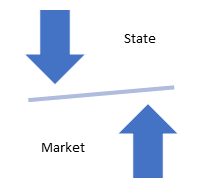
- Outdated 20th-century view of an Economy
For decades politicians have relegated us householders to a role as ‘consumers’. We’ve been told we need an economy something like that in the picture above where the business sector becomes the driver of an ever-growing economy, benefits ‘trickle down’ to all, and the government is on hand to sort out any issues. It was a political idea called ‘neoliberalism’. But while this system was meant to work out for everyone, it’s increasingly clear to every ‘man in the street’ that it is failing. The whole system seems broken. Well, perhaps it is! More and more economists and global political thinkers believe this political idea is well past its use-by-date if it ever had one, and I agree!
This neoliberal economic model was never about reality, merely how a few reasonably brainy economists wildly over-simplified economic thinking down to a basic model so people could ‘get it’. And they did! Because of the model’s simplicity and the needs of the time, this neoliberal model of ‘free market economies’ and ‘decoupling environmental issues from economic growth’ swept across the world. Embraced first by Margaret Thatcher and Ronald Reagan in the 1980’s, New Zealand followed soon after. This same over-simplified idea that ‘a growing economy will make everybody thrive’ underpins practices of the Far North District Council today.
Neoliberal politics saw the Far North District Council’s role shift from coordinating services on behalf of householders to becoming an economic driver in the region. When problems developed from business sector activities which couldn’t be resolved by the Council, that same ‘Yes, but..” response came to the fore with justification or blame in place of local people working together to develop solutions. Far North Holdings became a commercial business arm no longer open to control by the public, accountability for decisions taken and outcomes achieved by FNDC narrowed to financial measures while accountability for social, cultural and environmental wellbeing was pushed aside.
In the depths of our being, we sense the issues all around us, threatening our wellbeing and that of our beloved natural environment. The gap between wealthy and poor is growing, pollution of our environment is more and more obvious, mental and physical health is patchier, and loneliness is at an all time high. We feel the system is doomed and unable to create the wellbeing we need so we householders have increasingly disconnected from both local and national politics. We are left with that useless but understandable pastime of railing angrily at ‘them’ out of frustration. And while many sense that blaming ‘them’ is having little effect, just flogging a dead horse, what else can be done?
Well, hey, remember neoliberalism was just one story that a few guys dreamed up to help us get a handle on the complexity of the workings of national economies. As political journalist, George Monbiot [3] puts it, “Neoliberalism is dead: we need a new story”. Lets get real: those people and organisations to whom we address our ‘they should do something’ rants are themselves powerless within a broken system. Surely, we must look into alternatives?
The good news is that a new political model is now visibly emerging around the world. It’s emerging here in the Far North too, you just may not be aware of it yet. Often termed the “Politics of Belonging”[3], it’s based around a newer wiser model of the economy[4] (see diagram) that progressive economists these days realise better depicts the real world.
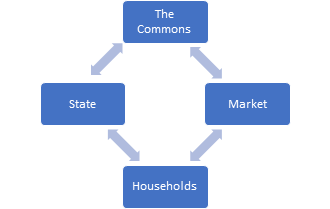
- The 4 drivers of a 21st-century Economy.
Now a way to resolve the challenges we face in the 21st century becomes clear. Look carefully, can you see how we householders are now not merely portrayed as ‘consumers’ but understood as playing a vital role in driving our economy? Householders have power, just as the State and Business sectors do. Indeed, more so, for we are also the ones that look after and create the vitality of the commons, those shared resources that belong to us all that are so vital to our national economy.
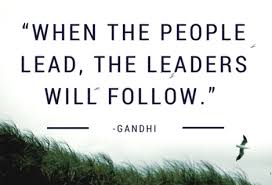
This is what is so exciting, so empowering, knowing that what we householders do makes an essential difference to the way the nation runs. So, if we aren’t as powerless as we’ve led ourselves to believe in recent years, can what we Far North householders do make enough difference to allow our region to flourish? I believe so.
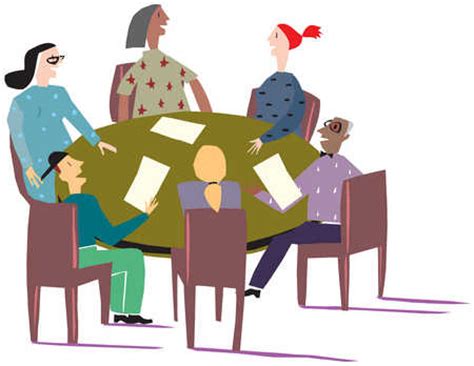
There’s an African phrase, ‘Sihamba nabahambayo‘ which means, ‘We take along with us those who are ready for the journey’[1]. My next blog, ‘From Rubbish to Flourish Part Two: There is no ‘them’’ is subtitled, ‘It’s too lonely by ourselves but ‘easy as’ when we do stuff together with others’. In this blog, you will also discover if you are a ‘Drifter’, an ‘Anchor’, a ‘Voyager’ or a ‘Treasure’! You may find it’s just the journey you’ve been waiting for.
[1] Dare not Linger: the Presidential Years. Nelson Mandela & Mandla Langa (2017).p. 31. https://us.macmillan.com/books/9780374134716
[3] https://www.youtube.com/watch?v=kisXBXBycn8
[4] https://www.youtube.com/watch?v=1BHOflzxPjI
-
IS WASTE REALLY INEVITABLE?
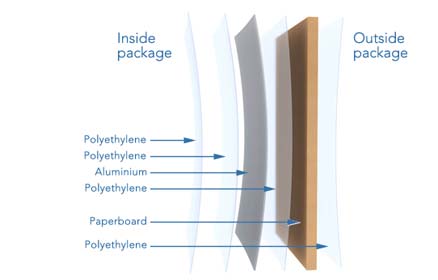
Is it time to consider how we, the citizens of New Zealand have ended up with a 4000 tonne mountain of unwanted paper and plastic recycling near Thames highlighted on the News this week? [1]As an increasing number of us realise, this build-up of recycling is just one visible tip of a much larger waste eruption that faces us, but where did it all go so wrong? *
The inevitability of waste is a myth! It’s very recent. Just a short time ago, we, the people of NZ, handed over our responsibility for deciding what to do with things we no longer needed. Are you aware for example that a number of Pacific languages such as I-Kiribati traditionally contained no word for ‘waste’? (Biodegradable plant material was simply placed on vacant land or recycled within taro pits for compost, while human and other waste was disposed of into the reef for final removal by the incoming tide). It was just part of daily life. Pacific middens containing long-extinct horned turtle bones in Efate, Vanuatu, date back 2900 years: as individuals and as local communities we took care of our own discards on our own land.
The same cultural practices that had worked for taking responsibility of our own discarded items accompanied the early migrations to Aotearoa NZ. As early as the 14th century at Wairau Bay, carbon dating of moa egg shell and bones shows how locals took responsibility for their discards within their own whenua. In pre-colonial times, Maori communities maintained their well-being through a complex system of sustainable processes with different products such as shellfish waste, human waste and shavings from wood carving each dealt with separately. At the industrial Pa sites of Heretaunga and Castle Point evidence of early separation of discarded products for ‘recycling’ has been found; stone, shell and bone flakes were set aside and stored for conservation and re-use. Captain James Cook praised the practices of communities in Poverty Bay, noting that “Every house, or every little cluster of three or four houses, was furnished with a privy, so that the ground was everywhere clean. The offals of their food, and other litter, were also piled up in regular dunghills, which probably they made use of at a proper time for manure”.
Even in early colonial NZ, while populations remained small, unwanted materials were disposed of on people’s own land or within the community. After the 2011 Christchurch earthquake, the excavation of Edward Hiorn’s property, an early settler who arrived in 1862, uncovered a number of rubbish pits. One pit contained tin and iron while 1037 artifacts including ceramics, glass bottles, clay pipes, shoes and clothing were found in a further large pit at the back of the property.
The pivotal moment came at the end of the 19th century when we started to congregate in towns and cities. Once the idea caught hold that ‘miasma’, a gas emanating from putrefying matter, was causing disease outbreaks, public health anxieties became so strong that the state took over the municipal collection and disposal of rubbish. What would have happened if in the 1880s in Wellington for example, we’d looked into how to avoid discarding items and materials rather than scavenger carts collecting household and business refuse and dumping it in piles to be burnt at the City Council Yards?
Once we as producers, individual citizens and local communities washed our hands of responsibility and put discarded material into the hands of municipal and government bodies, it was ‘out of sight and out of mind’. It has since been so very easy to view ‘waste’ as an unfortunate by-product of society for which we need take no personal responsibility.
The era of ‘waste management’ was born. Rather than reflecting on the relative benefit to our brothers and sisters of all living species of eradicating the concept of ‘waste’, we allowed the focus to shift to centralised policy and technological solutions.
For manufacturers too, this acceptance by citizens that the State should take full responsibility for discarded products and packaging removed any requirement for businesses to take the living world and its future wellbeing into account. With this problem streamlined, the call after World War II to rebuild national economies led to the creation of the ‘consumer society’ and the advent of the ‘chemical age’. The mountains of waste we left others to manage ramped up. The advertising industry used ever more creative product packaging to promote mass production and disposable products, while at the same time the composition of discarded products changed as wonderful new plastics emerged from the petro-chemical industry. Almost imperceptibly at first, a new level of complexity in managing materials discarded as end-of-life waste began. By celebrating the benefits of convenience over durability, we normalised disposable plastic products and single-use packaging.
Today the impact of this can be seen in the production of composite materials, of which Tetrapaks are a well-known example (see pic). We view these as highly efficient ‘cheap’ and ‘disposable’ products because we, along with fellow citizens and business directors, close our minds to block out uncomfortable environmental and social externalities. (In NZ those Tetrapak containers that are recycled are processed at the Materials Recovery Facility in Onehunga and shipped in bales to Korea, India and Australia. They are then soaked in water to separate the paper from the plastic and/or aluminium layers. Its a hugely complex and inefficient process, but we gain a feel-good factor: extracted wood fibre content can be turned into products like cardboard boxes and toilet paper. For Pacific island countries, the economics of such a process render it infeasible.) The number and complexity of such products is growing, creating complex waste streams which are too difficult or too costly to sort and process: often the entire waste stream gets sent to landfill.
Back in the 1980’s, the time my own adulthood began to bloom, it was already evident that problems arising from poor waste disposal were not just land-based dumpsite issues but affecting the marine environment across the Pacific. As far back as 1991 the NZ researcher Gregory emphasised the need to educate the public about the environmental problems in the oceans arising from the ‘indiscriminate disposal of plastics and other persistent synthetic compounds’. Even at that stage Gregory was predicting the seriousness of the marine plastics issue, ‘It is unlikely that these problems can ever be solved by regulation,’ he stated, and pinned his own hopes on ‘technological advances’. Along with the rest of us, embedded in ‘solid waste managment’ thinking, he too failed to question the responsibility of citizens and businesses for preventing materials that need to be discarded to arise in the first place. Twenty-five years on, it seems the narrative is unchanged. Yet does the answer really lie in technological solutions? And is waste really inevitable? What if we went back to having to discard items in our own backyards – would we still allow that packaging into our homes?
*This Zero Waste Granny is currently undertaking research within a Masters in International Development. My research topic – how the inspirational Maori Zero Waste organisation, Para Kore, may provide a different way of approaching our current waste crisis. Above is the first of six myths I am discovering about modern solid waste management approaches which prevent us finding deep solutions to living in harmony and restoring the natural world in NZ.
[1] https://www.tvnz.co.nz/one-news/new-zealand/chinas-ban-foreign-waste-wake-up-call-nz-environmentalists
-
BOTTLE DEPOSITS – WILL OUR LOCAL MP TAKE UP THE CAUSE?
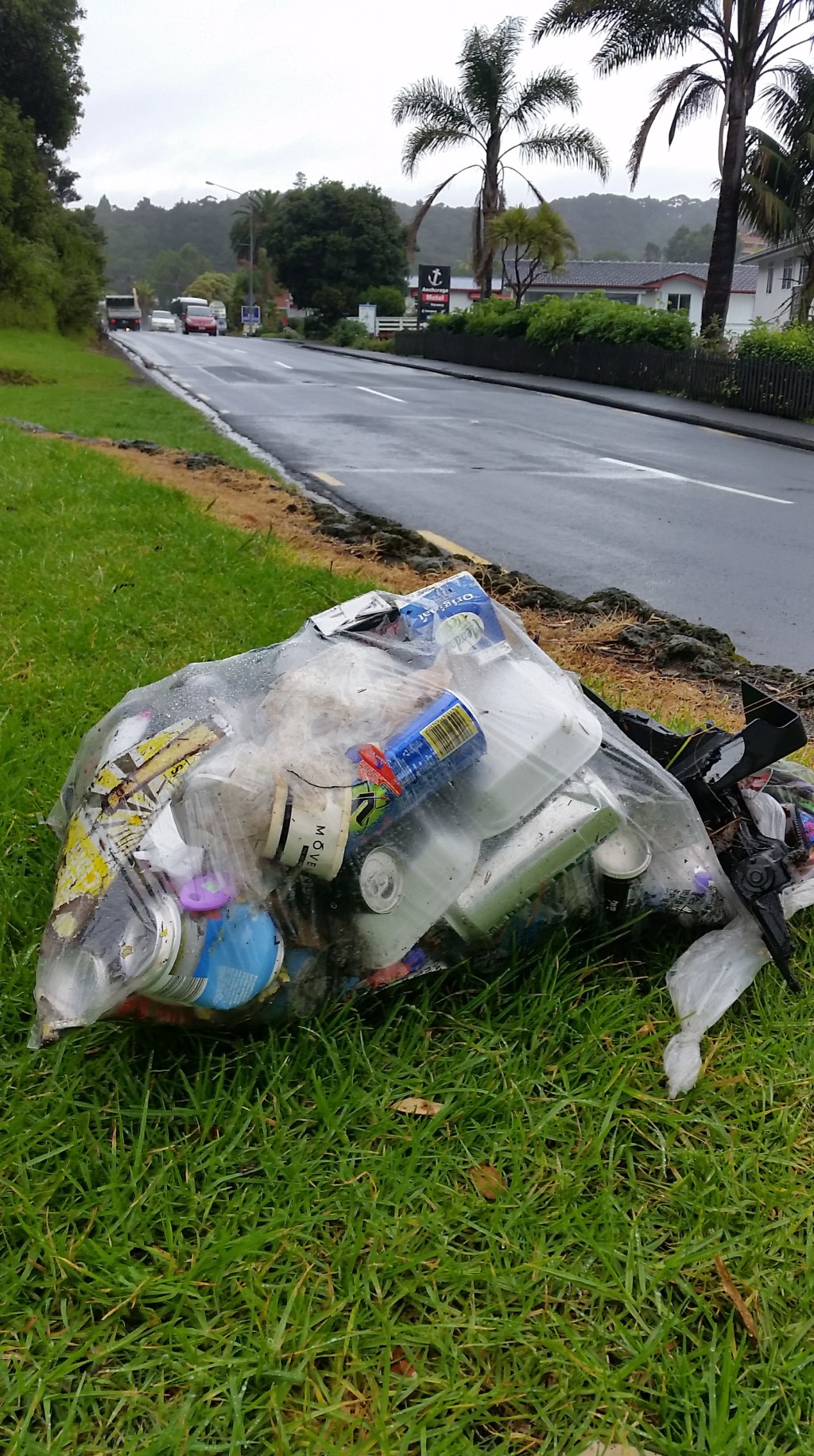
I love the way that here in NZ we have true local area representation in parliament. Hence I am approaching our local MP who last year signed his name to petitioning the government for refundable bottle deposits. Now it seems hard to contact him…. Latest email sent 10 February 2018 (correspondence as from 1st January below): Dear Matt I and many who share the zero waste kaupapa here in the Far North are waiting to hear how you can represent our voice in Parliament. Would you be willing to let me know what you will do for us so that I can pass it on to all those others in our Social Media groups?
Sincerely Jane B
Ps pic attached shows the 43 bottles and cans – amongst other stuff – that I collected on a walk yesterday morning in the 500m stretch up the hill and down the other side from Paihia Beach to Te Haumi Beach. I believe it speaks for itself…
Email sent 1 Febrary 2018 Hi Matt
I’m not an expert, just a passionate Far North Citizen, concerned about getting ‘all our ducks in a row’ so together we look after the mana of the whenua and moana of our region. I see the importance of these deposits not just for their own sake but o restore and regenerate our mana for the sake of us, the people of the Far North, currently using these items, our ancestors and our children. We aren’t, in my opinion, doing well right now either at generating environmental mana nor our own. Bottle deposits become a lead in to our regaining a greater felt connection with the natural world as what we do each day shows us that we are looking after it rather than defacing it. That increase in our own mana spills over into enhancing connection with one another. It’s a bigger picture than it may look at first…..
My understanding is that the main work on this has been done by Envision http://www.envision-nz.com/projects/ – check out the 2015 report, The InCENTive to Recycle, looked at the effectiveness of bringing back bottle refunds (cash for containers) to lift recycling rates in New Zealand. Also an Auckland Council commissioned, independent cost benefit analysis of the Envision model released in December 2017
The people who form the NZ Product Stewardship Council are also knowledgeable about this area. https://www.nzpsc.nz/faq/ and I am sure would be keen to provide you with what ever further information you need.
As you may be aware Scotland has recently joined the countries using the scheme – and Coca Cola is on board with the idea. , Britain is looking into it seriously https://www.nzpsc.nz/uk-impacts-of-a-deposit-refund-system-for-one-way-beverage-packaging-on-local-authority-waste-services/
and as I pointed out before , Australia looks like this :
Quite honestly – what is there not to like?
Jane
Email received 1 February 2018 Hi Jane
Do you have info from overseas jurisdictions that we could model any proposed changes in NZ on.
Email sent 1 February 2018 Dear MattI imagine you may be now back at work and I believe you will be interested to read of what is happening in New South Wales:
“More than 50 million drink containers have been returned through the Return and Earn recycling program since it began in December 2017. NSW Environment Protection Authority Acting Chair and CEO Mark Gifford said daily returns are averaging 1.5 million drink containers. Weekends tend to be the busiest times for returns, with last Sunday peaking at over 1.8 million returns.” (http://wastemanagementreview.com.au/50-million-drink-containers-collected-return-earn/)
As you are now well known amongst Far North citizens anxious to see refundable deposits on drinks containers from your pre-election commitment to this in Russell last year, would you now be willing to clarify what you will do to ensure advanced deposits are in place on all bottles and cans by the end of this year for the benefit of us all, the citizens of New Zealand and the other living creatures with whom we share this common world?
Jane B
Email received 17 January 2018 Hi Jane
I’m still on holiday will get back to you later.
Regards Matt King Northland MP
Email sent 17 January 2018 Good morning Matt
As I walked up Seaview Road this morning, in the first 250 metres I picked up – amongst other discards – these bottles and cans – see pic attached. It reminded me that I haven’t yet heard back from you regarding what you are going to do for us your constituents and the wellbeing of the Far North environment regarding ensuring a bottle deposit scheme is in place for all bottles and cans in NZ by the end of 2018.
As you are now well known amongst Far North citizens keen to see this go from your pre-election commitment to this in Russell last year, would you now be willing to clarify what you will do to ensure advanced deposits are in place on all bottles and cans by the end of this year?
Jane b
Email sent 5 January 2018 Hi Matt
While you are discussing the bottle deposit scheme with your colleagues, this will I think be really helpful – a short video that explains the whole system and how it works – wish I’d seen it earlier! https://www.youtube.com/watch?v=vKhzcq_bSq4
I will wait to hear what you think.
Sincerely Jane B
Email sent 2 January Hi Matt
My understanding is that it doesn’t affect retailers at all apart from a very minor increase in the price of drinks. The drinks companies add the 10c per drink bottle for example and pay this into a fund managed by Stakeholders. Community recycling depots refund the 10c to the person who brings in the bottle and are reimbursed from the managed fund. (You will see the full costs and benefits to all Stakeholders including local and central government and the drinks industry set out in the Envision Report (see below).
As the money is invested in the meantime these funds and the interest earned add to those obtained from the sale of the product by the centres to recycling businesses and just about cover the whole cost of the system. What I like is that these centres bring jobs to the regions too – as well as taking the costs away from Councils and onto those directly involved, producers and consumers – to me this looks like a win-win for us the people of the Far North. And the great thing is that the legislation is already in place in the 2008 Waste Minimisation Act – it just needs the will to put the scheme in place. I know so well from my personal discussions that the Kiwi public are absolutely behind it; they see it as a no-brainer.
(For your information, drinks companies are coming on board across the globe. See for example this article ‘Coca-Cola backs Scottish bottle deposit scheme calls’ http://www.bbc.com/news/uk-scotland-scotland-politics-39055909 )
In response to your first request for back up information, I have now located the 2015 Envision Report that I was seeking (you will find the full report at this link and I believe it will provide the clarity you need to discuss the issue further with your colleagues https://drive.google.com/file/d/0By5tj62u3HilUzZfSGNGTk5vd1k/view )
Here are a few salient points from the report:
KEY FEATURES OF THE Container Deposit Scheme proposed in this report are:
- Government declares beverage containers a priority product requiring a mandatory product stewardship scheme to be put in place and sets a system target rate of 85%
- A minimum refundable 10-cent deposit applies to all beverage containers
- A Managing Agency is set up by the beverage industry and other stakeholders
to coordinate and manage the flow of materials and funds through the system
- The Business and Social Enterprises sets up a collection system of convenient drop-
off points where the public can receive refunds for their containers.
BENEFITS
The predicted benefits of the model include:
- At least double the quantities of all beverage containers recovered (with a
target of 85%)
- At least 45,865 additional tonnes of containers diverted from landfill (an
increase of 43%)
- At least 700 million additional containers diverted from landfill (an increase of 74%)
- Potential savings to NZ ratepayers of between $26million and $40million per
annum from refuse collection savings (based on bag rates of between $2 and $3
per bag)
- Reduced litter and litter control costs
- Reduced costs to councils and ratepayersthrough higher kerbside recycling revenues
- Increased business opportunities for recyclers as a result of the increased
volumes of clean recycled materials
- Up to 2,400 new, entry-level to managerial- level jobs spread throughout the country
- New business opportunities for entrepreneurs to set up collection depots
- New income streams for social service groups who can collect containers
for refunds and also to set up social enterprises to operate collection depots
Please get back to me with your thoughts. I’m here to assist.
Jane B
Email received 2 January 2018 from Matt King
I went on the website and watched the short video question I have is this would be a huge burden to retailers and who would pay.
Regards Matt King Northland MP
Email sent 2 January 2018 Hi Matt, I appreciate your positive response.
Just checking with those that know more than me what would be the best information to send you. Here’s one recent article about whats happening in the UK for you in the meantime… http://www.telegraph.co.uk/business/2017/12/22/recycling-giant-backs-mps-call-uk-plastic-bottle-deposit-scheme/
I will be back to you soon. Jane B
Email received 1 January 2018 Hi Jane
Happy to look into this. Send me the information I need it helps when similar countries have such a scheme that makes it easier to sell to the law makers.
Regards Matt King Northland MP
Email sent 1st January 2018 Hi Matt
I hear more and more concern – from people in the Far North both in person and online, anxious about the amount of rubbish on the roadsides and in the streams and on beaches. A lot of this is plastic bottles, glass bottles and drink cans.
You told me at the Russell Birdman Festival that you are in favour of these advanced deposits. By the end of this year every State in Australia will have introduced a deposit system – will you as our local Far North MP push New Zealand to do this too for the sake of our whenua and moana here in the Far North. It needs your help. We the people of the Far North need your help.
The facts are indisputable – have a look at https://kiwibottledrive.nz/solution/ if you would like more information. The campaign was started and is still being driven by a resident of the Far North, Warren Snow from Kaitaia. I have copied him into this email. I am sure he would be keen to provide you with more information if required. The FNDC is all in favour . It looks like deposit refunds will be introduced in Scotland and the UK before long …. https://www.theguardian.com/environment/2017/oct/11/plastic-bottle-deposit-return-scheme-could-save-englands-councils-35m-a-year http://www.telegraph.co.uk/business/2017/12/22/recycling-giant-backs-mps-call-uk-plastic-bottle-deposit-scheme/
Matt, will you please put your weight behind advanced deposits – young Nats may be keen to take this up too if they haven’t already – lets get this in action for the sake of us all here in the Far North and our children and grandchildren’s future.
Meanwhile, I and 2 others are working to put a water drinking and bottle refilling fountain into the Paihia waterfront – we are doing what we can, can you please do your bit too.
Hei konā mai i roto i ngā mihi /Goodbye for now & thank you
Jane
-
NO MAYORAL RESOLUTION, NOT EVEN A RESPONSE!
February 14th 2018
“Dear John
I have a need to know that I am looking after the wellbeing of my brothers and sisters of all species. I also have a need for respect.
It is hard for me to meet these needs from your continued lack of response to the letter and gifts that I sent in a spirit of goodwill and friendship during the first week of the New Year. I feel sad and concerned.I wrote requesting your leadership in an area which I genuinely I believe is of importance to all of us citizens of the Far North and I have many fellow Far North residents following the outcome with interest as they too await your response.
Let us work together on behalf of Papatuanuku/Mother Earth and for the good of the people alive now, our ancestors and the people that will follow.
I look forward to hearing that FNDC will embrace the Ecostar certification department by department, completing this throughout by Easter 2018.
Sincerely
Jane B ”
-
IS PICKING UP LITTER TOO SMALL A DROP IN AN OCEAN OF RUBBISH?
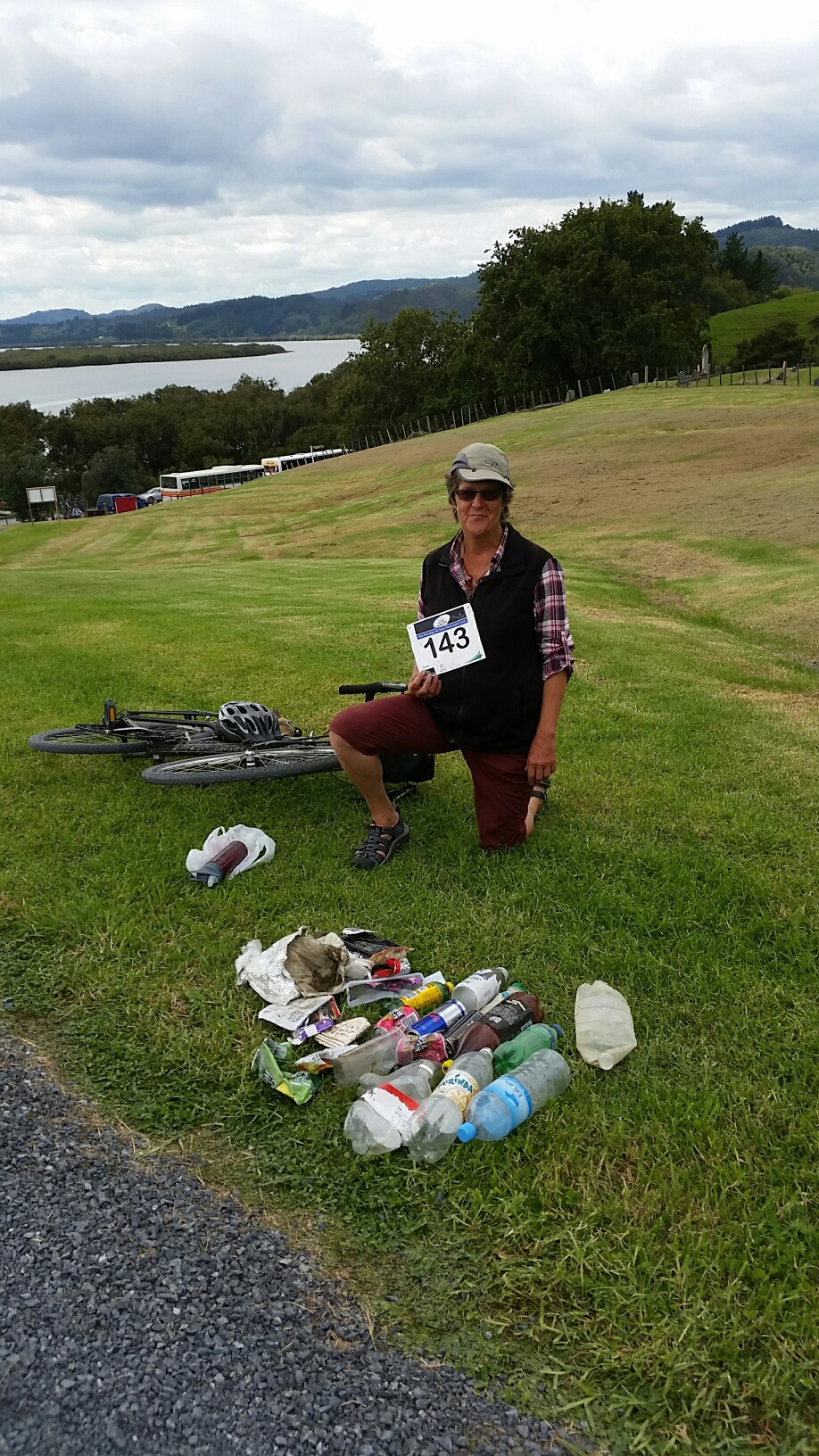 “We used to pick up litter ourselves until they took away most of the bins”, says the woman as she walks past with her partner, out for their morning exercise. I’d like to respond in a way that encourages her to restart, to tell her all the reasons why during my morning walk I collect what others discard. I want to suggest that the current location of bins could still work for them but my words don’t come out right: I mumble something about hoping they enjoy their walk, and my chance to speak up is lost.
Dear Reader, in hindsight I realise what I want to tell this couple. Why, even in the face of the enormity of the ‘Great Pacific Garbage Patch’ and my awareness that globally we allow discards that would fill a rubbish truck to enter the oceans every minute, I still believe in the value of picking up litter! Despite the enormity of this issue that tears at my soul demanding I feel powerless and defeated, amplified by a regular chorus of “If other people aren’t doing anything, why should I?”, I still regularly pick up other people’s discards. I missed sharing these ten ideas with that walking couple so would you be willing to listen instead?
- First, do you know the Starfish story? ‘Along a beach strewn with starfish as far as the eye could see that had washed up on the sand walked an old priest and a young boy. Every so often as they walked, the elderly man would bend down, pick up a starfish and toss it back into the sea. “Why are you bothering? Asked the young boy, “Cant you see its hopeless, there are far too many. You’ll never make a difference.” The old priest replies, “Well, young man, I made a difference to that one.” ‘ I often think of that traditional story as I pick up a piece of plastic wrapping. I picture one fish, one seabird or the dolphin that won’t now get sick from consuming this particular plastic bottle top or lolly wrapper.
- ‘People find a natural joy in contributing to the world’s wellbeing’, says one of the people who most influences my thinking, Marshall Rosenberg, founder of NVC (https://en.wikipedia.org/wiki/Nonviolent_Communication). I certainly feel it – perhaps it has a physiological basis in seratonin or endorphins or something – I just know that when I am feeling stressed, weary, cross and out of sorts, I have only to push myself to get up and out for a walk, taking a re-used bread bag and picking up litter, to return home 40 minutes later refreshed, regenerated and in good spirits!
- I know am not alone. By picking up things discarded into our environment, I join a growing community around the world. With this belonging comes a badge of hope. When I think of the small group in Mumbai (https://edition.cnn.com/2017/05/22/asia/mumbai-beach-dramatic-makeover/index.html), the NZ charity Sustainable Coastlines started by a Kiwi surfer, or the young Australians who set up the ‘Take 3 for the Sea’ ( http://www.take3.org/) challenge, I feel humbled to be amongst these eco-active giants, my brothers and sisters in this shared kaupapa, and doing my small ‘bit’ seems easy.
- Personally I just don’t feel comfortable when I see rubbish lying around. Perhaps its my inbuilt sense of order or maybe what I learnt to do as a child, but picking up litter and not leaving it around makes me feel easier.
- Whether I understand it literally or not, the vision of birds, plants and we humans all descended from Tane, fish from Tangaroa, and insects from Whiro who in turn are all descended from Papatuanuku, is a powerful one. We are all connected within the great circle of life. The health and security of one is the health and security of us all.
- Something lying on the surface of a beautiful patchwork would stop me enjoying its full beauty. Why wouldn’t I pick something off the ground so I can enjoy the full natural harmony of a vista of plants or a stream or the beach?
- By carrying items to the nearest bin, or home for recycling, I’m energised to ask our representatives for change. Today I email Matt King our local MP to request his support for refundable bottles and cans. Next week I’ll contact David Parker, our Environment Minister on the same issue or a member of our community board about local recycling bins. If things are to change, our representatives need to be aware of what we the people of NZ care about.
- I have two marvellous small grandsons. I want to look after their world as best I can. My hands can help just a little. My experience is that littles add up. Its their future.
- I gain a powerful sense of mana myself in looking after the environment. I gain self respect as well as respect from those whose opinions I value.
- Its fun! If you don’t believe me, try watching Kiri Danielle, the young Kiwi who without criticism or comment, races across her skateboarding area before she starts; in just a few minutes making a world of difference (https://web.facebook.com/100008990497923/videos/1755698608073139/?hc_ref=ARRo_oR3PiRokRP8T4qXu1wrBh_MxE0mVHTwZon3IQMZFXsPz7kGCQ5GK6H7hDy50Vw&pnref=story).
Picking up litter is just a tiny piece of a ‘tukutuku panel’ of strands each of us needs to consider weaving if we are truly to make a difference. Is it the whole answer? No, absolutely not. It is the ‘ambulance at the bottom of the cliff’ and we need to put much of our energy into rethinking our choices on what we do and what we eat, re-organising our workplaces, and requesting change from packaging stakeholders and decision makers. So is picking up litter a meaningful thing to do? Well, as you see above, I believe the answer is a tenfold ‘Yes’!
If you would like to comment (or join me on an empowering walk!) I’m always keen to listen. You can connect with me at zerowastegranny@gmail.com or join the Far North Zero Waste Facebook Group. #togetherwecandoit

About Me
The sky is not completely dark at night. Were the sky absolutely dark, one would not be able to see the silhouette of an object against the sky.
Follow Me On
Subscribe To My Newsletter
Subscribe for new travel stories and exclusive content.

